AI-generated illustration; not an actual property or inspection finding.
A newly constructed home should be in excellent condition when you receive the keys. But even a home that has never been occupied can have installation problems, incomplete work, or components that do not function as intended.
Yes, new construction homes can benefit from independent inspections. Building-department inspections, builder walkthroughs, and independent home inspections serve different purposes. Each can contribute useful information, but none guarantees that every problem has been discovered.
For buyers in Tallahassee and North Florida, understanding when and why to schedule an inspection can help them make better decisions before closing and during the early years of ownership.
Why inspect a brand-new home?
Constructing a home involves several trades working at different stages. Framing, roofing, electrical, plumbing, HVAC, insulation, and finishing work must all come together.
Even with qualified contractors and appropriate oversight, mistakes and oversights can occur.
Depending on the stage of construction and accessibility, an independent inspector might observe:
- Plumbing leaks or visible installation concerns.
- Electrical defects or components that do not function properly.
- Damaged, displaced, or incomplete insulation.
- Roof-covering, flashing, or exterior weatherproofing concerns.
- HVAC operating problems or condensate drainage issues.
- Site drainage conditions that could direct water toward the building.
- Incomplete or improperly functioning fixtures and finishes.
These are examples of possible observations, not an assumption that a particular builder or property has defects.
Doesn't the building department already inspect the home?
Building officials conduct inspections required under applicable construction and permitting procedures.
Those inspections focus on the requirements within the building department's jurisdiction.
An independent home inspector evaluates the visible and readily accessible conditions of installed systems and components within the agreed inspection scope and documents findings for the client.
A certificate of occupancy or final building approval is an important construction milestone. It should not be interpreted as a warranty against defects or a guarantee that every installed component is functioning properly.
Similarly, an independent home inspection does not certify full code compliance or replace the building department's responsibilities.
Three inspection opportunities during new construction
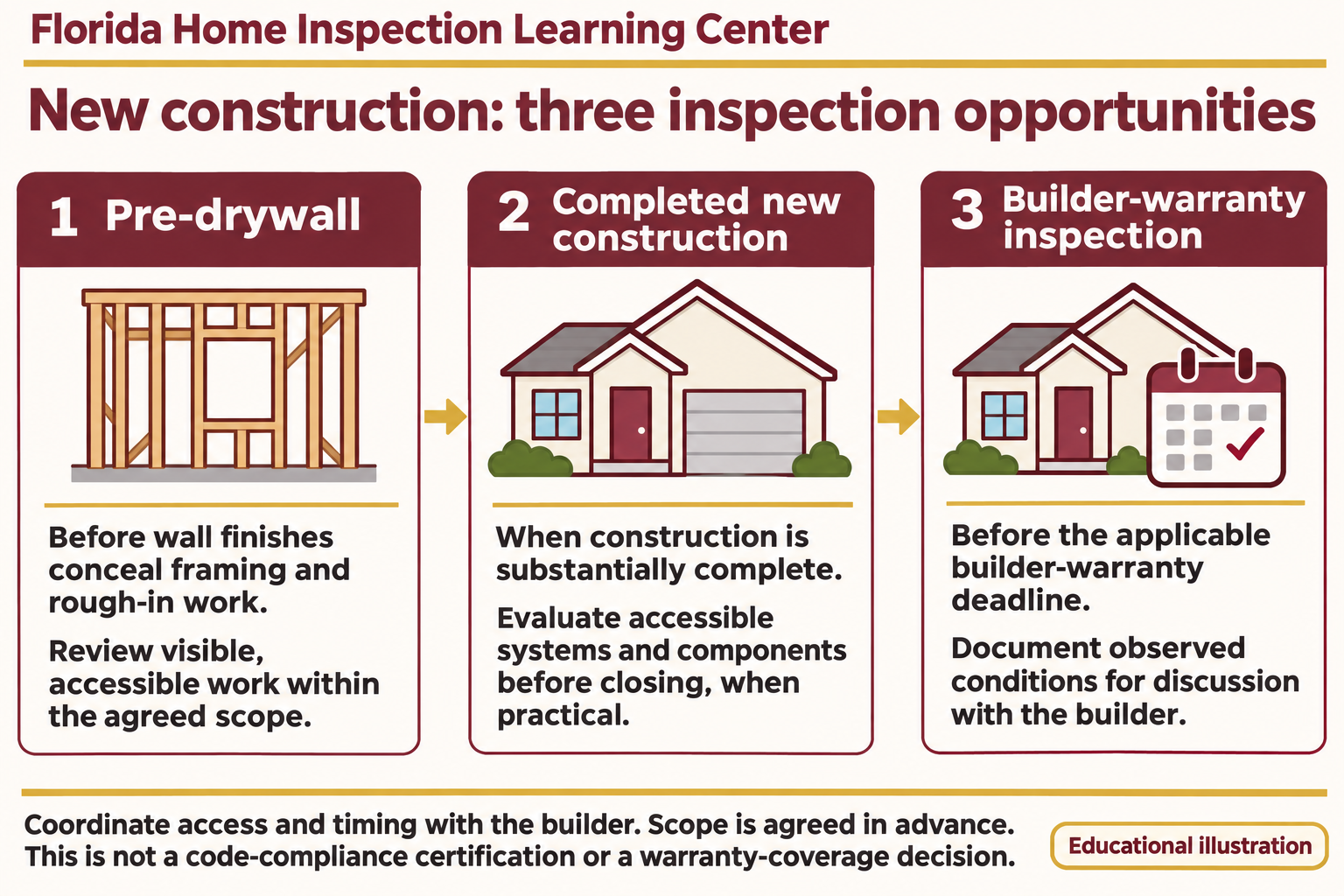
ACL Home Inspections offers pre-drywall inspections, completed new-construction inspections, and builder-warranty inspections. Each is performed under an appropriate agreed scope and provides information at a different stage of the home's development.
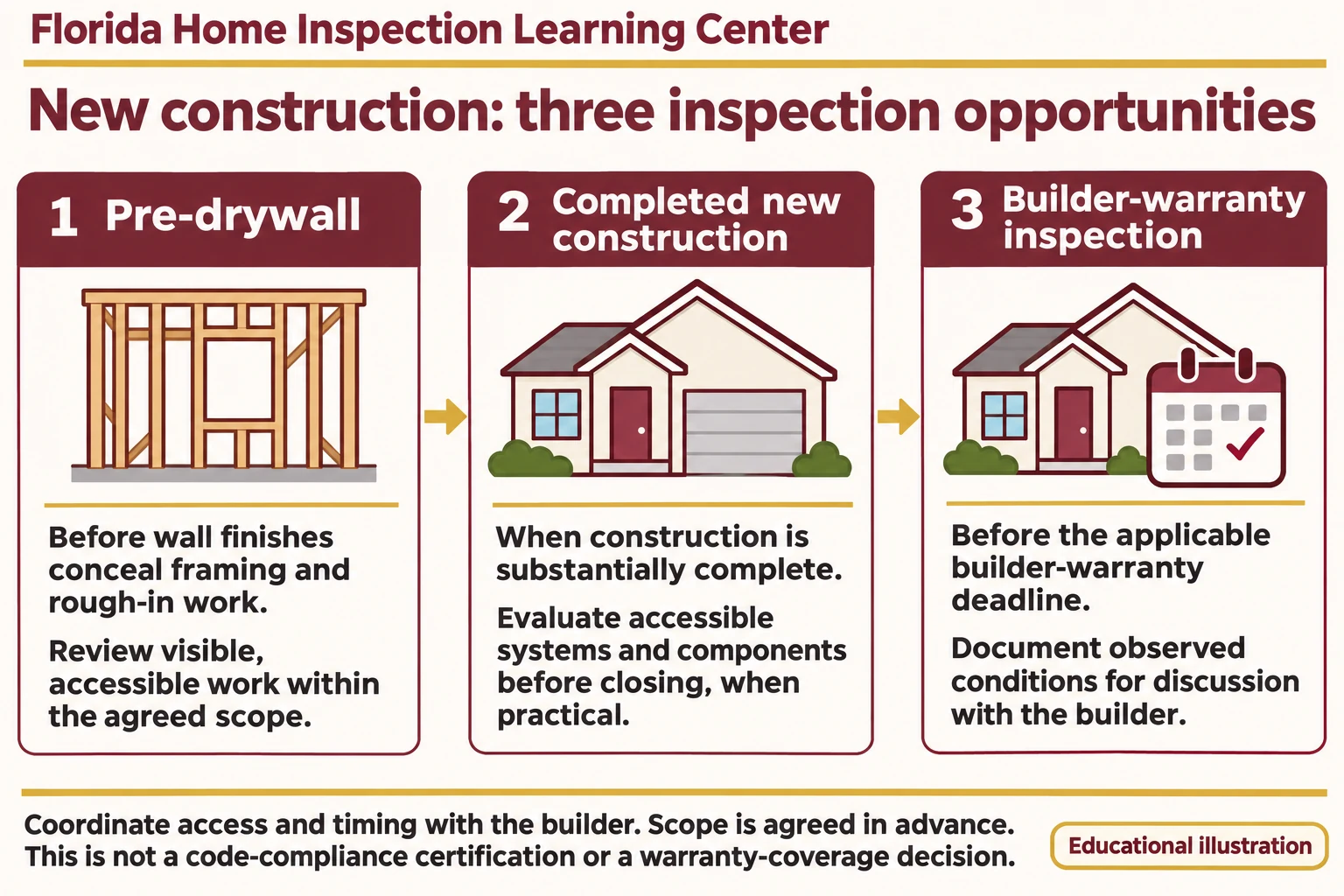
AI-generated educational illustration. Symbols are conceptual, not inspection evidence or construction instructions.
Text description: Pre-drywall: before wall finishes conceal framing and rough-in work; review visible, accessible work within the agreed scope. Completed new construction: when construction is substantially complete; evaluate accessible systems and components before closing when practical. Builder-warranty: before the applicable deadline; document observed conditions for discussion with the builder. Coordinate access and timing with the builder and agree the scope in advance. This is not code-compliance certification or a warranty-coverage decision.
Open the full-resolution illustration
1. Pre-drywall inspection
A pre-drywall inspection occurs after selected framing and rough-in installations are complete but before wall and ceiling finishes conceal them.
At this stage, an inspector may be able to observe framing components, visible electrical and plumbing installations, HVAC ductwork, penetrations, and other accessible construction details.
The main advantage is visibility. Once finishes are installed, many components cannot be examined without removing materials.
Timing is important. The builder must authorize access, and the relevant installations must be sufficiently complete to evaluate.
A pre-drywall inspection is a separately scoped service, not a substitute for government-required construction inspections or a completed-home inspection.
2. Completed new-construction home inspection
A completed new-construction inspection is generally most useful when the home is substantially complete, utilities are available, and the installed systems can be operated under appropriate conditions.
The inspector evaluates readily accessible systems and components, documents observed concerns, and provides recommendations for correction or further evaluation when warranted.
Scheduling should allow reasonable time for the builder to review findings before closing. Inspecting too early, while significant work remains unfinished, may limit what can be evaluated.
The inspection is still visual and non-invasive. Finished walls, concealed connections, and inaccessible areas remain outside direct observation.
3. Builder-warranty inspection
Many builders provide limited warranties, but the duration, exclusions, and claims procedures depend on the specific warranty.
An inspection before an applicable warranty deadline may help identify conditions that have become visible or apparent after occupancy.
These could include drainage concerns, moisture-related conditions, equipment performance problems, or changes in finishes.
The inspector can document observed conditions and recommend further evaluation. The written builder warranty determines contractual coverage and the claims process.
A warranty inspection does not establish that the builder is legally responsible for every observed condition.
Isn't the builder's final walkthrough enough?
Builder walkthroughs are useful for identifying incomplete items, reviewing finishes, demonstrating equipment, and discussing maintenance.
An independent home inspection has a different purpose.
It focuses on evaluating installed systems and components within its scope and communicating observable conditions to the buyer.
Both can be valuable, but one does not automatically replace the other.
What happens when an inspector identifies a concern?
Not every finding is a major defect.
Some items involve adjustments, unfinished work, or maintenance. Others may require repairs or evaluation by an appropriately qualified contractor, specialist, or engineer.
Buyers should review the findings, understand the recommendations, and communicate through the builder's established process.
When appropriate, documenting corrective work and arranging follow-up evaluation can help clarify whether reported conditions have been addressed.
For real estate professionals, a well-organized report supports communication among the buyer, builder, and transaction participants without turning observations into unsupported conclusions.
What a new construction inspection cannot guarantee
A home inspection cannot confirm that every concealed component was installed correctly.
It ordinarily does not include destructive testing, opening finished walls, engineering analysis, verification of every building-code provision, or prediction of future performance.
Inspection conditions, construction status, access, weather, and available utilities may affect what can be evaluated.
Where uncertainty remains, the report should explain the limitation or recommend further evaluation when appropriate.
From the Inspector: Inspection timing matters
The most useful inspection is one performed at the appropriate construction stage.
A pre-drywall inspection provides an opportunity to observe work that will later be concealed. A completed new-construction inspection evaluates the substantially completed home. A warranty inspection provides a later opportunity to identify observable concerns before an applicable warranty deadline.
These inspections answer different questions.
They are not guarantees, and they should not be treated as interchangeable.
Before scheduling, ask these questions
- Does the builder permit independent inspections at the proposed stage?
- Is the work sufficiently complete for the intended inspection?
- Will appropriate access and utilities be available?
- How should inspection findings be submitted?
- Is there time for the builder to review and address concerns?
- What warranty deadlines and written notice requirements apply?
The bottom line
New construction does not eliminate the value of independent inspection.
The goal is not to assume that a builder has made mistakes. It is to provide the buyer with independent, understandable information about observable conditions and appropriate next steps.
ACL Home Inspections offers pre-drywall, completed new-construction, and builder-warranty inspections in Tallahassee, North Florida, and surrounding areas. Contact ACL to discuss your home's construction stage and which inspection service is appropriate.