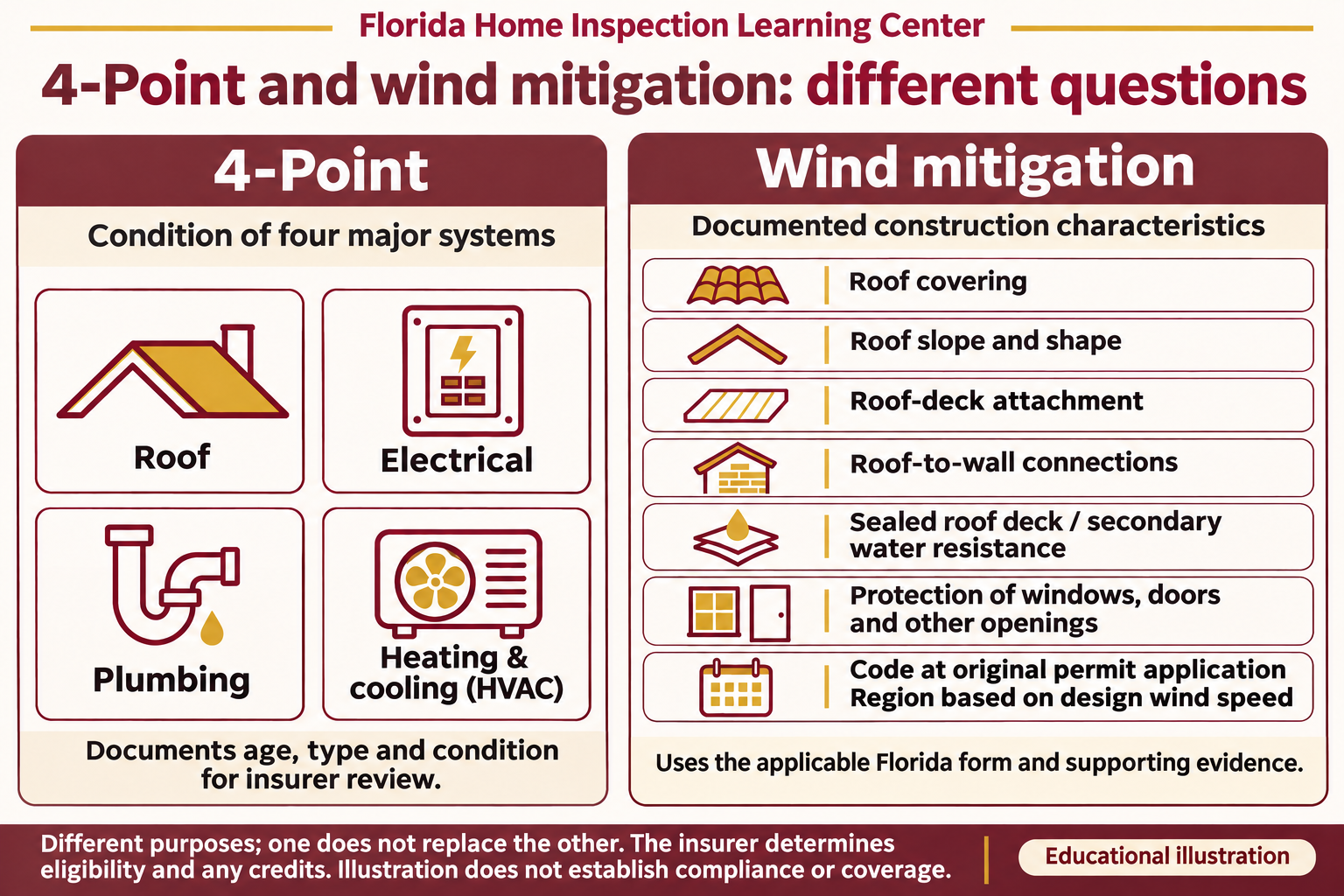
AI-generated illustration; not an actual property or inspection finding.
If you're purchasing a home in Florida, renewing your homeowners insurance, or comparing insurance options, you may be asked about a 4-Point inspection, a wind mitigation inspection, or both.
Although the two inspections are often scheduled during the same visit, they have different purposes.
A 4-Point inspection documents information about four major building systems for insurance underwriting. A wind mitigation inspection documents specific wind-resistant construction features that may qualify for insurance premium credits.
Understanding the difference can help you obtain the documentation your insurance company needs.
What is a 4-Point inspection?
A 4-Point inspection focuses on four areas of a home:
- Roof: Roof-covering type, age, visible condition, and other information requested by the insurer.
- Electrical: Service equipment, panel and wiring characteristics, visible concerns, and other specified information.
- Plumbing: Supply and drainage materials, water-heating equipment, leaks, and relevant observed conditions.
- Heating and cooling: Installed HVAC equipment, available age or identification information, and observable condition or operation as applicable.
Insurance companies use the report as part of their underwriting process.
A 4-Point inspection is not a substitute for a full residential home inspection.
Does every older Florida home need a 4-Point inspection?
No universal age threshold applies to every insurer and every policy.
An insurance company may request a 4-Point inspection based on the property's age, characteristics, underwriting guidelines, or other considerations.
Before scheduling, ask your insurance representative whether a report is needed and whether the insurer requires a particular form or additional documentation.
Can a home fail a 4-Point inspection?
The inspection report documents observed conditions and provides the information requested for underwriting.
The insurance company decides how that information affects coverage eligibility.
Some conditions may lead an insurer to request repairs, further evaluation, or additional documentation. Other conditions may affect eligibility under that carrier's rules.
The inspection itself does not approve or deny insurance coverage.
The age of a particular system alone should not be presented as a universal reason for automatic insurance denial.
What is a wind mitigation inspection?
A wind mitigation inspection documents characteristics of a building that are associated with resistance to wind damage.
Examples of the features addressed by the applicable Florida form include:
- Roof-covering information.
- Roof-deck attachment.
- Roof-to-wall connections.
- Roof geometry.
- Secondary water resistance.
- Opening protection and other qualifying characteristics.
The specific categories and verification requirements are established by the applicable form.
Why would a homeowner request one?
Certain qualifying construction characteristics may affect the windstorm portion of a property insurance premium.
The inspection documents verified features. The insurer determines the applicable credits under its approved rating rules.
A wind mitigation inspection does not guarantee a discount, and not every documented characteristic will necessarily qualify for a particular premium credit.
Florida's updated wind mitigation form
Florida's Uniform Mitigation Verification Inspection Form, OIR-B1-1802 (Rev. 04/26), took effect April 1, 2026.
Inspections performed on or after that date must use the revised form.
The updated form includes additional categories and specific documentation requirements for verifying reported features.
Forms completed before April 1, 2026, may remain valid when they meet the applicable requirements.
A completed wind mitigation form is generally valid for up to five years, provided there have been no material structural changes or discovered inaccuracies.
Insurers may independently verify reported information. A form's validity period should not be interpreted as a guarantee of premium credits or a prohibition against requests for additional documentation.
How are the two inspections different?
|
4-Point inspection |
Wind mitigation inspection |
| Primary purpose |
Insurance underwriting information |
Documentation of wind-resistant features |
| Main subject |
Roof, electrical, plumbing, HVAC |
Specific building construction characteristics |
| Main potential benefit |
Providing information needed for underwriting |
Potential windstorm premium credits |
| Full home inspection? |
No |
No |
| Determines coverage or premium? |
No |
No |
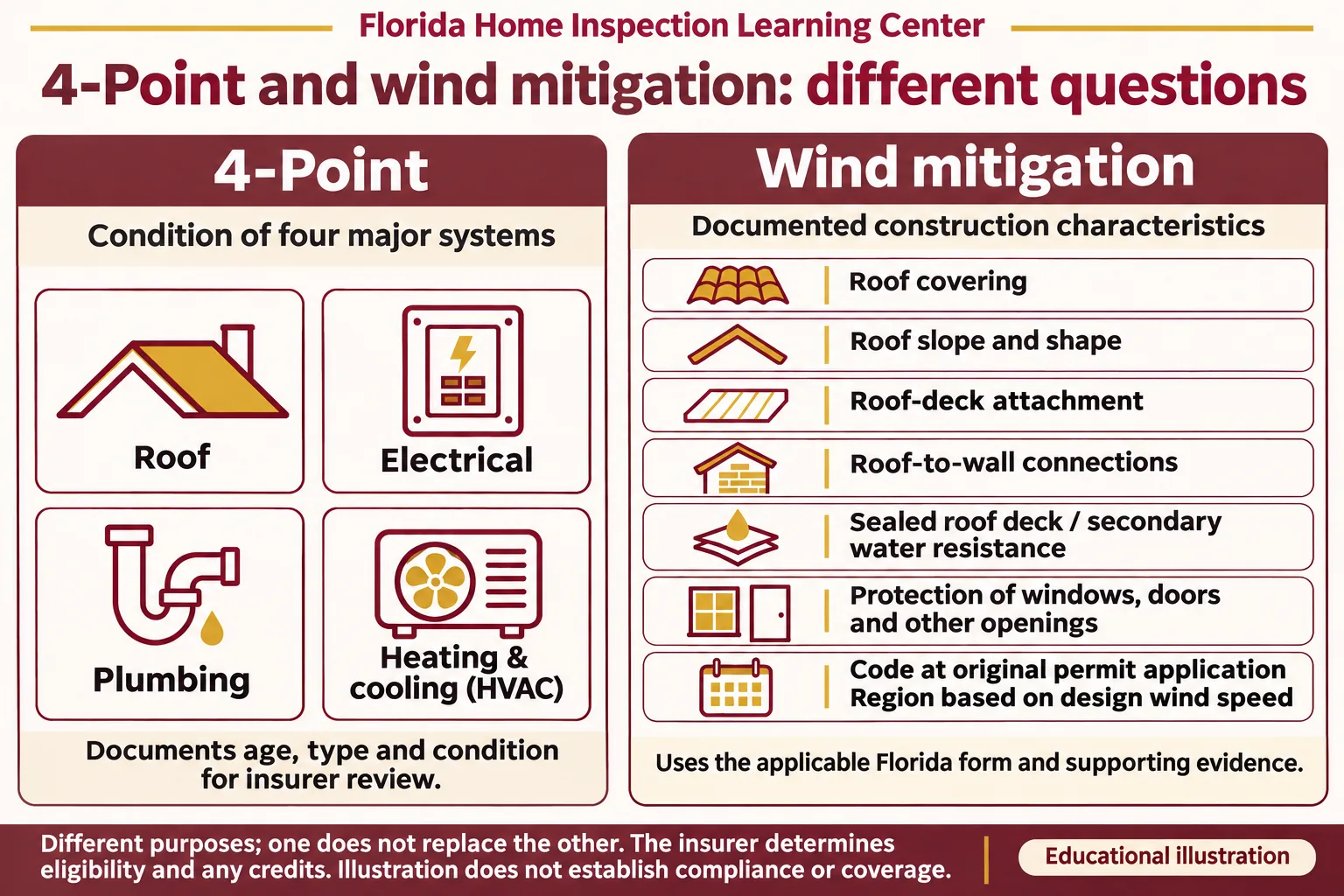
AI-generated educational illustration. Symbols are conceptual, not inspection evidence or construction instructions.
Text description: 4-Point addresses the roof, electrical, plumbing, and heating/cooling systems, documenting age, type and condition for insurer review. Wind mitigation documents roof covering, slope and shape, roof-deck attachment, roof-to-wall connections, sealed roof deck or secondary water resistance, opening protection, the building code applicable at the original permit application and the region based on design wind speed, using the applicable Florida form and supporting evidence. The inspections have different purposes; one does not replace the other. Insurers determine eligibility and credits. The illustration does not establish compliance or coverage.
Open the full-resolution illustration
Can they be performed together?
Often, yes.
A homeowner or buyer may arrange a 4-Point inspection, wind mitigation inspection, and full home inspection during the same appointment, depending on the services ordered and the property's readiness.
Coordinating services may reduce the need for separate visits, but each report has its own purpose and documentation requirements.
A full home inspection report does not automatically satisfy an insurer's request for insurance-specific forms.
What if the roof was recently replaced?
A new roof can provide useful information for both reports, but it does not make the reports interchangeable.
For the 4-Point inspection, the insurer may be interested in roof age, visible condition, and supporting records.
For wind mitigation, the verified roof-related construction features and supporting documentation govern the applicable entries.
A replacement roof does not automatically establish that all wind mitigation categories qualify for the highest available credits.
Permits, installation documentation, product information, and photographs may help establish specific characteristics when accepted by the applicable form instructions.
What should homeowners prepare?
Before the inspection, gather the insurer's request and any available records relevant to the property.
These may include roof permits, replacement documentation, construction records, and information about qualifying opening protection.
Ensure accessible areas needed for the ordered services are available, including relevant attic access and installed equipment.
If a feature cannot be verified, the report must reflect the applicable documentation and verification requirements rather than assume favorable construction characteristics.
What should real estate agents understand?
Insurance documentation can affect transaction timing.
Agents can help buyers confirm insurance requirements early, arrange access, and coordinate delivery of reports.
However, neither an agent nor an inspection report should promise that a particular finding will produce coverage or a specific discount.
The insurer retains responsibility for underwriting and rating decisions.
Which inspection do you need?
If your insurance company requests a 4-Point inspection, schedule that service.
If you want to document wind-resistant features for potential insurance credits, ask whether a wind mitigation inspection is appropriate.
If you are purchasing a home, consider a full home inspection for a broader evaluation of accessible systems and components.
All three serve distinct purposes.
The bottom line
A 4-Point inspection provides information about four major building systems for insurance underwriting.
A wind mitigation inspection documents features relevant to potential windstorm premium credits.
Neither report guarantees insurance approval, premium savings, or the absence of concealed defects.
ACL Home Inspections provides 4-Point and wind mitigation inspections in Tallahassee, North Florida, and surrounding areas. Contact ACL to discuss your insurance documentation needs and the available inspection options.